
Jason Palmer Brings 20 Years of Submarine Experience to Highway
When Jason Palmer was a young man considering what to do with his life, he walked into a military recruiting office with an unusual request. He said, “Give me the hardest thing you’ve got.”
The answer: Submarines.
 Jason didn’t know much about them, so he asked one simple question: Was it hard? When the recruiter told him it was hard and that not many people wanted to do it, Jason immediately responded, “Then I’ll take it.”
That decision turned into a 20-year career in the U.S. Navy, nine deployments and travel to 47 countries. Today, Jason has traded the confines of a submarine for a desk at Highway Transport, where he supports the busy Chicago region as part of the Customer Service team.
And as different as those two worlds might seem, Jason has discovered they have more in common than you might think.
Listening for What Others Might Miss
Jason specialized as a sonar technician aboard Los Angeles-class fast attack submarines. For hours at a time, he would sit at a screen wearing headphones, listening to an ocean that he says is much louder than most people realize. To an untrained ear, much of it might sound like television static. Jason’s job was to recognize the slightest deviation in that noise and determine what caused it. That required intense concentration.
During a sonar watch, Jason could spend six hours staring at a screen, taking and giving verbal commands without looking away. Over the course of 20 years, something that initially felt almost impossible became second nature. This makes his current job somewhat ironic.
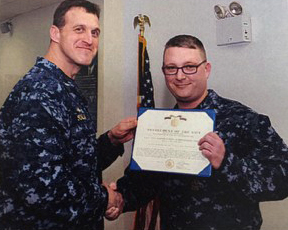
“I laugh sometimes when I think about it,” Jason said. “The job that I’m doing now, we have pods and everything in Chicago.
I’m wearing headphones. I’m staring at a screen.” He concludes, “I was trained for this, just not for the trucking industry.”
The equipment and mission may have changed, but many of the skills haven’t. The job requires you to pay attention, communicate clearly and recognize when something doesn’t look right. You must solve problems before they become bigger and stay focused when things get busy.

Jason specifically asked for that last part when he interviewed with Highway.
He told the Customer Service Director he wanted to know where the company needed the most help, and where the stress level was highest. The answer he got was Chicago. For a guy accustomed to long days beneath the ocean, that sounded just fine.
When Safety Is Everyone’s Responsibility
Perhaps the strongest connection between Jason’s Navy experience and Highway Transport is safety. On a submarine, safety isn’t a department. It isn’t a slogan. It’s something every crew member must own.
Jason remembers a saying from his submarine days: “A fire will actually kill us faster than a torpedo.”
That reality meant sailors weren’t simply trained to respond when something went wrong. They were trained to constantly look for the small things that could eventually become big problems.
“We are very well trained to see problems before they turn into a fire,” Jason said. “We’re always second-checking ourselves, looking around for possible problems.”
That’s a mindset he believes translates directly to Highway and the responsibility that comes with transporting bulk liquid chemicals. Jason continues, “If all of us took a piece of that and implemented it into our job every day, I have no doubt we’d be the safest carrier on the road.”
One Crew, One Mission
There was another lesson Jason learned beneath the ocean: teamwork isn’t optional. A submarine roughly 380 feet long could carry around 145 to 160 sailors and privacy was scarce. Crew members worked long hours, ate together, lived together and depended on one another. Once the hatch closed and the submarine descended, there wasn’t much opportunity to walk away when something became difficult.

“You’re kind of stuck in that sense,” Jason said, “but that’s also a blessing at the same time. It doesn’t give you an out to give up.”
That environment taught him resilience, but it also taught him something about leadership.
After leaving the military, Jason initially had to adjust to the fact that not everyone approaches a job with the same training, experiences or expectations he had developed during two decades in the Navy. Instead of expecting everyone to think exactly like he does, Jason realized his role is to help bring out the best in the people around him.
“I can motivate them toward bringing out the best parts of themselves and working as a team,” he said.
That may be one of the most valuable lessons he brings with him to Highway.
Finding a New Crew at Highway
Jason had logistics experience before joining Highway, but bulk chemical transportation was a new world. What attracted him to customer service was something much simpler: he likes people, communication and solving problems.
“Throw a problem at me,” he said. “Let me try to fix it on all sides.”

Six months into his Highway career, Jason says the company has delivered on what he was told during the hiring process.
“Everything that was explained and discussed in the interview was 100% accurate, if not better,” he said. “I can’t say that about any interview I’ve done, military or otherwise.”
And for someone who spent 20 years understanding the importance of the people serving beside him, perhaps his strongest compliment for Highway is about the people he’s found here.
“I have encountered some of the greatest people outside the military I think I’ve ever met in my life here at this company.”
Twenty years, nine deployments, forty-seven countries and thousands of hours beneath the ocean has made Jason Palmer’s path to Highway Transport somewhat unconventional. But put him in a high-pressure environment, give him a problem to solve, surround him with a team and tell him that safety matters above everything else?
It turns out he’s been training for this job for a very long time.